
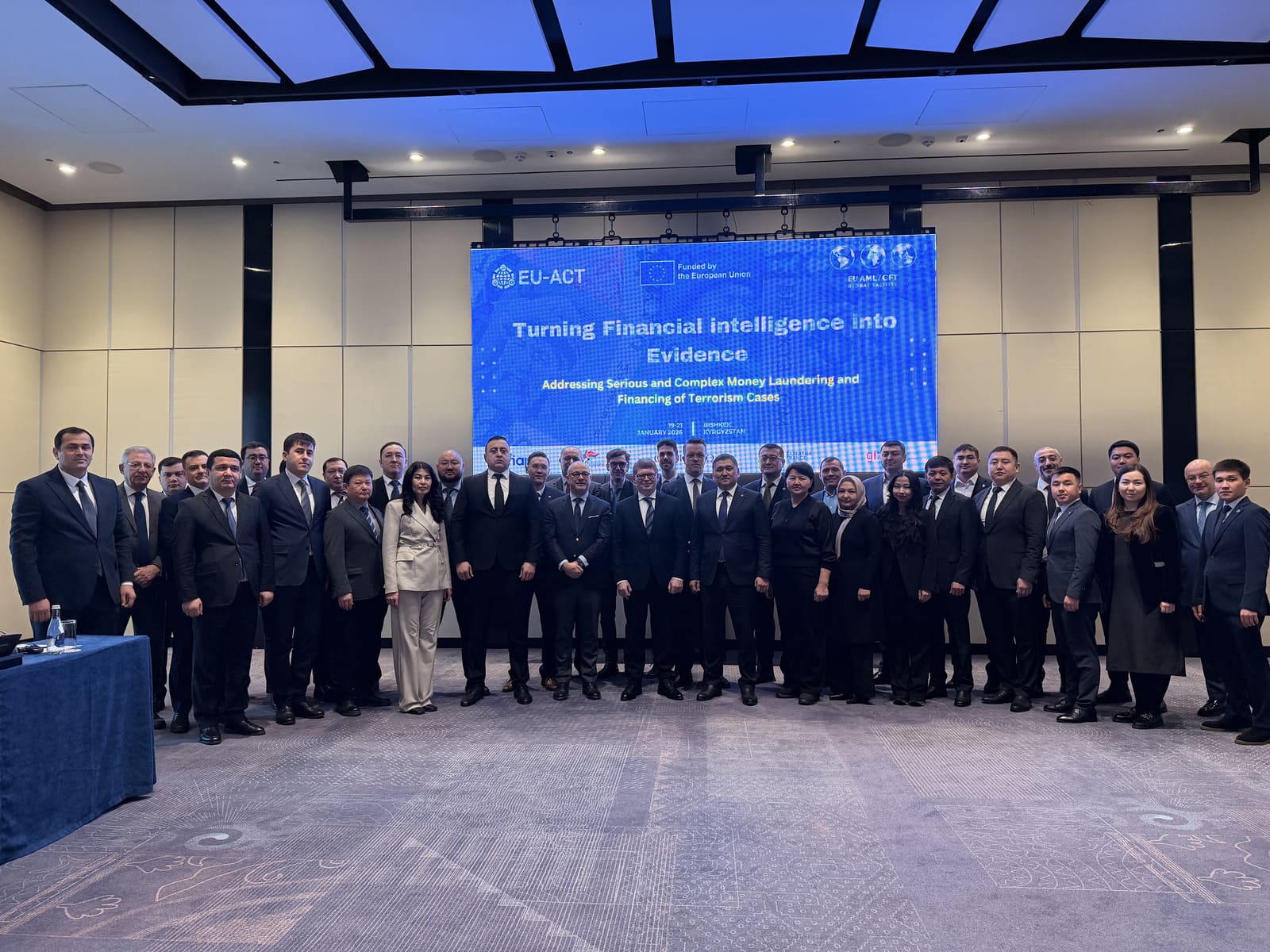
How do you transform financial intelligence into courtroom evidence that stands up to judicial scrutiny?
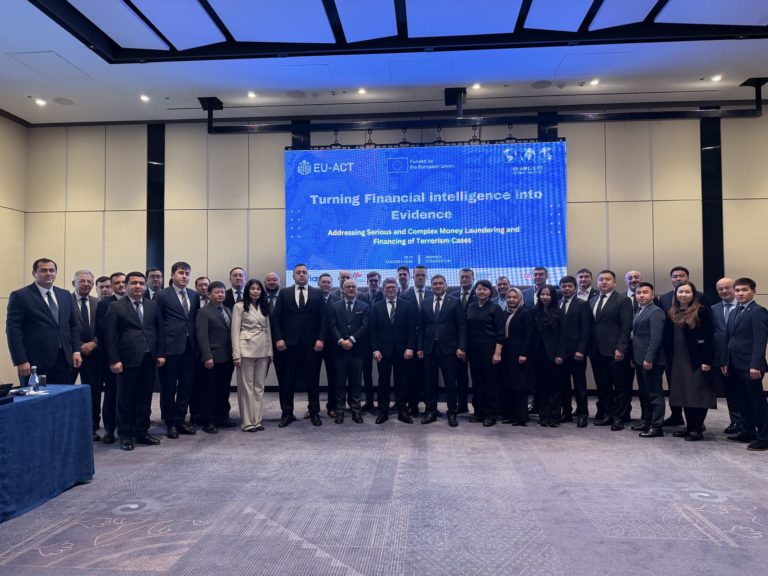
This was the central question addressed during a three-day regional workshop held in Bishkek, Kyrgyz Republic, from 19 to 21 January 2026.
Bringing together judges, prosecutors, financial intelligence analysts, investigators and law enforcement officers from Kazakhstan, Kyrgyzstan, Tajikistan and Uzbekistan, the event focused on bridging the critical gap between intelligence gathering and prosecution – a gap that criminal networks increasingly exploit to move illicit proceeds across borders.
Co-organised by the EU Global Facility on Anti-Money Laundering and Countering the Financing of Terrorism (EU Global Facility on AML/CFT) and the EU Action against Organised Crime and Terrorism (EU-ACT), the workshop was hosted by the Financial Intelligence Unit of the Kyrgyz Republic.
Addressing a Growing Security Threat
Organised crime is becoming more connected, violent and global. Criminal networks exploit global trade routes, digital technologies and weak governance to traffic drugs, weapons, and other illicit goods. Money laundering provides the financial infrastructure that enables these operations to grow, allowing criminals to legitimise proceeds, corrupt officials, and reinvest in further criminal activity.
In Central Asia, geographic position along major trade corridors, combined with evolving financial systems, creates vulnerabilities that transnational criminal organisations seek to exploit. Effectively disrupting these networks requires not only detecting suspicious financial flows but converting that intelligence into evidence strong enough to secure convictions and recover criminal assets.
Opening the workshop, EU Ambassador to Bishkek Rémi Duflot emphasised the strategic importance of the work: “Financial intelligence can and should play a central role in crime fighting, but must not remain an isolated product; it needs to be transformed into admissible evidence that can stand in court, support convictions and ultimately lead to the confiscation of illicit assets.”
From Theory to Practice: Building Operational Capacity
Over three intensive days, EU Global Facility and EU-ACT experts from France, Spain and Brazil helped practitioners to work through real-world scenarios and concrete challenges encountered when investigating complex financial crimes. Sessions covered:
- Parallel Financial Investigations: Techniques for conducting financial investigations alongside traditional criminal investigations, identifying asset flows while building the criminal case.
- Cross-Border Tracing and Mutual Legal Assistance: Practical approaches to following money across jurisdictions, requesting and providing international cooperation, and navigating differences in legal frameworks.
- Open Source Intelligence (OSINT): Methods for leveraging publicly available information to map corporate structures, identify beneficial owners, and corroborate financial intelligence.
- Asset Recovery and Confiscation: Mechanisms for freezing, seizing and ultimately confiscating criminal proceeds, including international asset forfeiture cooperation.
- Evidentiary Standards and Admissibility: Understanding what courts require, how to present financial intelligence in ways that meet evidentiary thresholds, and avoiding common pitfalls that undermine prosecutions.
The workshop addressed participants’ operational reality head-on, offering both best practices and potential solutions to obstacles they have encountered in their own jurisdictions
As EU AML/CFT Global Facility Team Leader David Hotte noted: “Financial crime doesn’t respect borders – and neither can effective responses to it. By bringing together representatives from across the penal chain, these workshops create the networks and mutual understanding that formal cooperation mechanisms alone cannot achieve.”
Building Regional Momentum
The Bishkek workshop represents the second phase of an expanding Central Asian initiative. In September 2024, the EU Global Facility on AML/CFT partnered with MASAK, Türkiye’s Financial Intelligence Unit, to convene practitioners from Central Asia in Ankara for similar peer-to-peer exchanges.
This regional approach creates sustained opportunities for professional networks to develop across borders. Participants from different countries and different parts of the criminal justice chain – financial intelligence units, police and security services, prosecutors, judges, customs and tax authorities – gain shared understanding of each other’s capacities, constraints and operational needs.
A follow-up regional workshop is planned for later in 2026 in Uzbekistan, continuing the momentum and allowing participants to share progress, challenges and evolving practices as they implement lessons learned.



 This project is funded by the European Union.